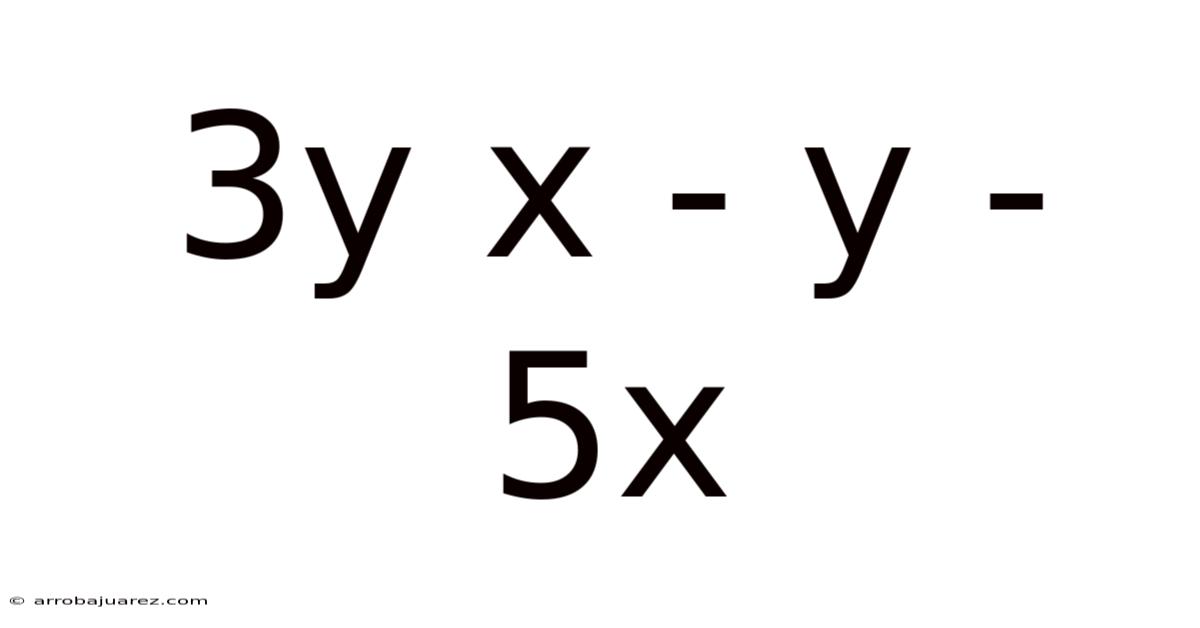
Unveiling the Secrets of 3y x - y - 5x: A thorough look
The algebraic expression 3yx - y - 5x might seem intimidating at first glance. That said, by breaking it down and understanding its components, we can reach its secrets and learn how to manipulate it effectively. And this guide will take you through the intricacies of this expression, exploring its properties, simplification techniques, and applications. We'll break down factoring, graphing (in a specific context), and how to interpret the expression in various scenarios Simple as that..
And yeah — that's actually more nuanced than it sounds Worth keeping that in mind..
Understanding the Components: A Foundation
Before we dive into manipulations, it's crucial to understand what each part of the expression represents But it adds up..
- Terms: The expression consists of three terms: 3yx, -y, and -5x. Each term is separated by addition or subtraction signs.
- Variables: The variables involved are x and y. These represent unknown quantities that can take on different values.
- Coefficients: Coefficients are the numerical factors multiplying the variables.
- In the term 3yx, the coefficient is 3.
- In the term -y, the coefficient is -1 (implicitly).
- In the term -5x, the coefficient is -5.
- Degree of Terms: The degree of a term is the sum of the exponents of the variables in that term.
- The degree of 3yx is 2 (since the exponent of x is 1 and the exponent of y is 1, and 1+1=2).
- The degree of -y is 1.
- The degree of -5x is 1.
Understanding these fundamental concepts is crucial for any further manipulation or analysis of the expression.
Factoring: Unlocking Hidden Structures
Factoring is a powerful technique used to rewrite an expression as a product of simpler expressions. While directly factoring the entire expression 3yx - y - 5x might not be straightforward, we can attempt to factor by grouping Simple, but easy to overlook..
Let's try to group the first two terms and see if we can extract a common factor:
- Grouping: (3yx - y) - 5x
- Factoring out y from the first group: y(3x - 1) - 5x
At this point, we notice that we're close to factoring the entire expression. And if we could somehow manipulate the -5x term to become (3x - 1) multiplied by something, we could factor further. This motivates a slightly more advanced technique.
Let's try to manipulate the expression to force a common factor. We want to introduce a term that allows us to factor (3x - 1):
-
Original Expression: 3yx - y - 5x
-
Factor y from the first two terms: y(3x - 1) - 5x
-
Aim: We want to rewrite the -5x term in a way that includes (3x - 1) as a factor. To achieve this, we can add and subtract a strategically chosen constant. Notice that if we had -5/3(3x - 1), we would get -5x + 5/3. So, let's add and subtract 5/3:
- y(3x - 1) - 5x + 5/3 - 5/3
- y(3x - 1) - 5/3(3x - 1) - 5/3
- (y - 5/3)(3x - 1) - 5/3
This manipulation is useful in several contexts, especially when trying to solve equations or analyze the behavior of the expression. The key takeaway is that sometimes you need to add and subtract the same term to reveal hidden factorizations.
Another approach, often more fruitful, is to consider the expression in the context of an equation. Let's say we want to solve 3yx - y - 5x = 0 for y. This forces us to factor the expression in terms of y:
- Original Equation: 3yx - y - 5x = 0
- Rearrange terms to isolate y terms: 3yx - y = 5x
- Factor out y: y(3x - 1) = 5x
- Solve for y: y = 5x / (3x - 1)
This is a significantly more useful result. Now we have y expressed as a function of x. This form reveals much more about the relationship between x and y.
Analyzing the Expression as a Function: y = f(x)
As we derived above, we can rewrite the expression (when set equal to zero) as a function: y = 5x / (3x - 1). Analyzing this function provides valuable insights:
- Domain: The domain of the function is all real numbers except for x = 1/3, because the denominator (3x - 1) cannot be zero.
- Vertical Asymptote: There's a vertical asymptote at x = 1/3. As x approaches 1/3 from the left or right, the value of y approaches infinity (either positive or negative).
- Horizontal Asymptote: To find the horizontal asymptote, we examine the behavior of the function as x approaches positive or negative infinity. Since the degree of the numerator and denominator are the same (both are 1), the horizontal asymptote is the ratio of the leading coefficients: y = 5/3.
- Intercepts:
- x-intercept: Set y = 0: 0 = 5x / (3x - 1). This is only true when x = 0. So the x-intercept is (0, 0).
- y-intercept: Set x = 0: y = 5(0) / (3(0) - 1) = 0. So the y-intercept is (0, 0).
By analyzing the function, we've gained a comprehensive understanding of its behavior, including its domain, asymptotes, and intercepts. This understanding is crucial for graphing the function and interpreting its meaning in different contexts.
Graphing the Function: Visualizing the Relationship
The function y = 5x / (3x - 1) can be graphed to visualize the relationship between x and y. The graph will show:
- A curve approaching the vertical asymptote at x = 1/3.
- A curve approaching the horizontal asymptote at y = 5/3.
- The graph passing through the origin (0, 0).
Graphing tools or software can be used to accurately plot the function and visualize its behavior. The visual representation complements the algebraic analysis, providing a more intuitive understanding of the relationship between x and y Most people skip this — try not to..
Applications and Interpretations
The expression 3yx - y - 5x (or its equivalent form y = 5x / (3x - 1)) can appear in various contexts, including:
- Optimization Problems: In optimization problems, you might encounter this expression as a constraint or as part of an objective function. Understanding its properties can help you find maximum or minimum values.
- Modeling Relationships: The expression can model a relationship between two variables x and y in various fields, such as economics, physics, or engineering. The specific interpretation depends on the context.
- Curve Fitting: If you have data points that appear to follow a hyperbolic trend, you might try to fit a curve of the form y = ax / (bx - c) to the data. The expression 3yx - y - 5x = 0 can be rewritten in this form.
The key is to recognize the underlying mathematical structure and apply the appropriate techniques to analyze and interpret the expression in the given context.
Solving Equations Involving the Expression
We've already touched upon solving the equation 3yx - y - 5x = 0 for y. On the flip side, we can explore other types of equations involving this expression.
Example 1: Solving for x when y is known
Suppose we are given that y = 2 and we want to find the value of x that satisfies the equation 3yx - y - 5x = 0.
- Substitute y = 2 into the equation: 3(2)x - 2 - 5x = 0
- Simplify: 6x - 2 - 5x = 0
- Combine like terms: x - 2 = 0
- Solve for x: x = 2
Example 2: Finding where the expression equals a constant
Suppose we want to find the values of x and y that satisfy the equation 3yx - y - 5x = 1. This is a more complex problem because we have one equation and two unknowns. We can, however, rewrite the equation and analyze it.
Real talk — this step gets skipped all the time It's one of those things that adds up..
- Rewrite the equation as: 3yx - y - 5x - 1 = 0
- Try to factor (as before, this is not trivial). Alternatively, express y in terms of x
- 3xy - y = 5x + 1
- y(3x - 1) = 5x + 1
- y = (5x + 1) / (3x - 1)
Now we have y as a function of x. We can analyze this new function similarly to how we analyzed y = 5x / (3x - 1) Turns out it matters..
- Domain: All real numbers except x = 1/3.
- Vertical Asymptote: x = 1/3.
- Horizontal Asymptote: y = 5/3.
These examples illustrate how to solve equations involving the expression and highlight the importance of algebraic manipulation and analytical techniques And that's really what it comes down to..
Further Exploration: Partial Derivatives (If Applicable)
While this expression doesn't necessarily require calculus for understanding its fundamentals, it's worth noting that if you're dealing with multivariable calculus, you could explore partial derivatives.
- Partial Derivative with respect to x: ∂/∂x (3yx - y - 5x) = 3y - 5
- Partial Derivative with respect to y: ∂/∂y (3yx - y - 5x) = 3x - 1
These partial derivatives give you the rate of change of the expression with respect to x and y independently. This can be useful in optimization problems in higher dimensions.
Potential Pitfalls and Common Mistakes
- Incorrect Factoring: Factoring requires careful attention to signs and common factors. Double-check your factoring by expanding the factored expression to ensure it matches the original.
- Dividing by Zero: When manipulating equations, be mindful of dividing by expressions that could be zero. This can lead to undefined results or incorrect solutions. Remember the domain restriction when y = 5x/(3x-1) where x != 1/3.
- Misinterpreting the Context: The meaning and interpretation of the expression depend heavily on the context. Always consider the units, constraints, and assumptions of the problem.
- Forgetting to add and subtract terms: As shown in earlier steps for factoring, sometimes adding and subtracting a well-chosen constant can make factoring significantly easier.
Conclusion: Mastering the Expression
The expression 3yx - y - 5x, while seemingly simple, offers a rich landscape for exploration and analysis. By understanding its components, mastering factoring techniques, analyzing it as a function, and applying it in different contexts, you can reach its secrets and gain valuable insights. Because of that, the key is to approach the expression with a combination of algebraic skills, analytical thinking, and a willingness to explore different perspectives. In real terms, remember to practice, pay attention to detail, and don't be afraid to experiment with different techniques. With dedication and persistence, you can master this expression and confidently tackle more complex mathematical challenges. The ability to manipulate and interpret algebraic expressions is a cornerstone of mathematical proficiency and opens doors to a wide range of applications in science, engineering, and beyond. Keep exploring, keep learning, and keep challenging yourself to deepen your understanding of the world of mathematics!
