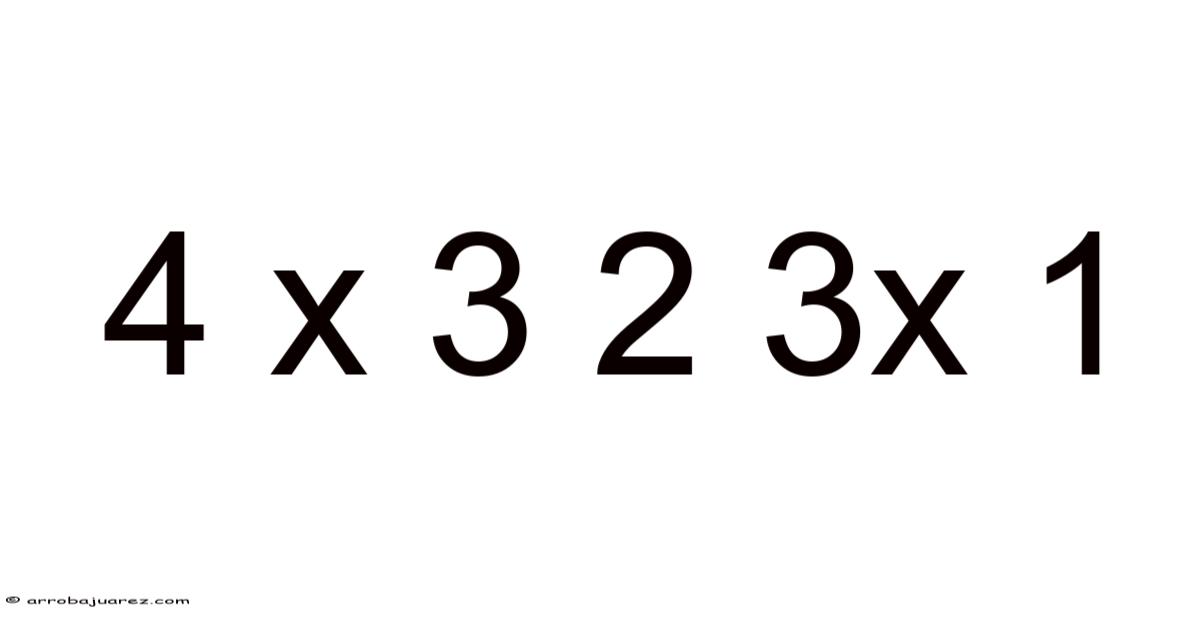
Unveiling the Magic Behind 4 x 3 + 2 - 3 x 1: A Journey Through Mathematical Operations
At its core, the expression 4 x 3 + 2 - 3 x 1 appears as a straightforward sequence of numbers and symbols. On the flip side, beneath this seemingly simple surface lies a fundamental principle governing mathematical operations: the order of operations. Understanding this principle is key to unlocking not just the solution to this specific problem, but also a deeper appreciation for the elegance and logic that underpin mathematics. This exploration will get into the mechanics of solving this equation, the reasons behind the established order, and the broader implications of these rules in the world of mathematics and beyond.
Decoding the Order of Operations: A Foundation for Accurate Calculations
Mathematics relies on a standardized system to ensure consistency and avoid ambiguity in calculations. Practically speaking, without a clear set of rules, the same expression could yield multiple, different answers, leading to chaos and invalidating mathematical reasoning. On top of that, the order of operations, often remembered by the acronym PEMDAS (Parentheses, Exponents, Multiplication and Division, Addition and Subtraction), provides this crucial framework. This order dictates the sequence in which mathematical operations should be performed to arrive at the correct solution.
- Parentheses (and other grouping symbols): Operations enclosed within parentheses or other grouping symbols like brackets and braces are always performed first. This allows us to prioritize specific calculations within a larger expression.
- Exponents: Exponents, which indicate repeated multiplication, are evaluated next. This includes squares, cubes, and any other power.
- Multiplication and Division: Multiplication and division are performed from left to right. These operations hold equal precedence, so the order in which they appear in the expression determines the sequence of their execution.
- Addition and Subtraction: Finally, addition and subtraction are performed from left to right. Similar to multiplication and division, these operations have equal precedence and are executed in the order they appear.
Step-by-Step Solution: Applying PEMDAS to 4 x 3 + 2 - 3 x 1
Now, let's apply the order of operations to solve the expression 4 x 3 + 2 - 3 x 1.
-
Multiplication: According to PEMDAS, we must first perform the multiplication operations. We have two instances of multiplication in this expression:
- 4 x 3 = 12
- 3 x 1 = 3
The expression now becomes: 12 + 2 - 3
-
Addition and Subtraction: Now, we perform the addition and subtraction operations from left to right:
- 12 + 2 = 14
- 14 - 3 = 11
So, the solution to the expression 4 x 3 + 2 - 3 x 1 is 11.
The "Why" Behind the Order: Understanding the Rationale
The order of operations isn't arbitrary; it's based on sound mathematical principles and aims to simplify complex expressions while maintaining consistency. Understanding the reasoning behind PEMDAS helps solidify its importance and makes it easier to remember.
- Parentheses: Prioritizing Relationships: Parentheses are used to group terms and define the scope of an operation. They signal that the enclosed operations should be treated as a single unit, overriding the standard order. This allows us to express complex relationships and dependencies between different parts of an equation.
- Exponents: Streamlining Repeated Multiplication: Exponents represent repeated multiplication. Performing exponents before multiplication and division ensures that we accurately calculate the repeated multiplication before incorporating it into the rest of the expression.
- Multiplication and Division: Inverse Relationships and Scaling: Multiplication and division are inverse operations; one undoes the other. Performing them before addition and subtraction reflects their role in scaling and distributing values within an expression. Multiplication can be seen as repeated addition, and division as repeated subtraction.
- Addition and Subtraction: Combining and Separating: Addition and subtraction are also inverse operations, representing the fundamental processes of combining and separating quantities. These operations are performed last, as they represent the final step in aggregating or reducing the values within the expression.
Real-World Applications: The Ubiquity of Order of Operations
The order of operations isn't confined to textbooks and classrooms; it's a fundamental principle that underlies countless calculations in various fields.
- Computer Programming: Programming languages rely heavily on the order of operations to interpret and execute code accurately. Compilers and interpreters follow PEMDAS (or its equivalent in different languages) to evaluate expressions and confirm that programs function as intended. Bugs and errors can arise if the order of operations is not correctly understood and implemented in the code.
- Financial Calculations: In finance, the order of operations is crucial for calculating interest, returns on investment, and other financial metrics. To give you an idea, calculating compound interest involves exponents, and accurately applying the order of operations is essential for determining the final value of an investment.
- Engineering and Physics: Engineers and physicists use mathematical models to describe and predict the behavior of physical systems. These models often involve complex equations with multiple operations. The order of operations ensures that these equations are solved correctly, leading to accurate predictions and reliable designs.
- Data Analysis: Data analysts use statistical software to process and analyze large datasets. These analyses often involve complex calculations that rely on the order of operations. Accurate application of PEMDAS is crucial for obtaining meaningful insights and drawing valid conclusions from the data.
- Everyday Life: Even in everyday situations, we implicitly use the order of operations. Here's one way to look at it: when calculating the total cost of items with discounts and taxes, we need to perform the multiplication and division operations (calculating discounts and taxes) before the addition operation (summing the costs).
Common Mistakes and How to Avoid Them: Mastering the Nuances
While the order of operations seems straightforward, certain common mistakes can lead to incorrect answers. Being aware of these pitfalls can help you avoid them.
- Ignoring Parentheses: The most common mistake is failing to recognize and prioritize operations within parentheses. Always start with the innermost set of parentheses and work your way outwards.
- Incorrect Order of Multiplication and Division: Remember that multiplication and division have equal precedence and are performed from left to right. Students sometimes mistakenly perform multiplication before division, even if division appears first in the expression.
- Incorrect Order of Addition and Subtraction: Similar to multiplication and division, addition and subtraction have equal precedence and are performed from left to right.
- Misinterpreting Exponents: make sure you understand what the base and exponent represent. Here's one way to look at it: (-2)^2 is different from -2^2. In the first case, the entire -2 is squared, resulting in 4. In the second case, only 2 is squared, and then the negative sign is applied, resulting in -4.
- Calculator Errors: Be cautious when using calculators, especially basic models. Some calculators may not follow the order of operations correctly. It's always a good idea to double-check your answers and understand how your calculator handles different operations. For more complex calculations, using a scientific calculator or a computer-based tool is recommended.
Advanced Applications: Extending the Concepts
The principles of the order of operations extend beyond basic arithmetic and into more advanced areas of mathematics.
- Algebraic Expressions: In algebra, the order of operations is essential for simplifying and solving equations. Complex algebraic expressions may involve multiple operations, variables, and grouping symbols. Understanding PEMDAS is crucial for manipulating these expressions and isolating the unknown variables.
- Calculus: Calculus involves concepts like limits, derivatives, and integrals, which often require complex calculations. The order of operations is used to evaluate these expressions and solve related problems.
- Complex Numbers: Complex numbers involve real and imaginary components, and operations on complex numbers require careful application of the order of operations. The rules for addition, subtraction, multiplication, and division of complex numbers are based on the fundamental principles of PEMDAS.
- Linear Algebra: Linear algebra deals with vectors, matrices, and linear transformations. Operations on matrices, such as matrix multiplication and determinant calculation, require a thorough understanding of the order of operations.
- Boolean Algebra: In computer science and digital electronics, Boolean algebra is used to analyze and design logical circuits. Boolean operations, such as AND, OR, and NOT, have a specific order of precedence that must be followed to ensure correct circuit behavior.
Mnemonics and Memory Aids: Mastering PEMDAS
Several mnemonics can help you remember the order of operations. The most common is PEMDAS, which stands for Parentheses, Exponents, Multiplication and Division, Addition and Subtraction. Other variations include:
- Please Excuse My Dear Aunt Sally
- Pretty Elephants Multiply and Divide At Sunset
Choose the mnemonic that works best for you and use it as a quick reminder when tackling mathematical expressions.
Practicing and Refining Your Skills: Building Fluency
The key to mastering the order of operations is practice. Work through a variety of problems, starting with simple expressions and gradually increasing the complexity. You can find practice problems in textbooks, online resources, and worksheets. Pay close attention to the order in which you perform each operation, and double-check your answers to ensure accuracy.
- Start with Simple Expressions: Begin with expressions that involve only a few operations, such as 2 + 3 x 4 or 10 - 6 / 2.
- Gradually Increase Complexity: As you become more comfortable, move on to expressions with more operations, parentheses, and exponents, such as (5 + 2) x 3 - 8 / 4 or 2^3 + (10 - 4) / 2.
- Work Through a Variety of Problems: Ensure you practice with different types of problems, including those with fractions, decimals, and negative numbers.
- Check Your Answers: Always verify your solutions to ensure you are applying the order of operations correctly. If you make a mistake, try to identify where you went wrong and learn from it.
- Use Online Resources: There are many online resources available, such as calculators, tutorials, and practice problems, that can help you improve your understanding of the order of operations.
4 x 3 + 2 - 3 x 1: A Cornerstone of Mathematical Literacy
Pulling it all together, the expression 4 x 3 + 2 - 3 x 1, though seemingly simple, highlights the importance of the order of operations in mathematics. In practice, mastering this fundamental principle is a crucial step towards developing mathematical literacy and confidence in problem-solving. The journey through this seemingly basic equation unveils a deeper understanding of the logical framework that underpins mathematics, revealing the elegance and power of a system designed for consistency and accuracy. So whether you're a student, a professional, or simply someone who wants to improve their mathematical skills, understanding and applying the order of operations will undoubtedly enhance your ability to work through the world of numbers with precision and clarity. Because of that, by adhering to PEMDAS, we can ensure consistent and accurate calculations, not only in academic settings but also in countless real-world applications. Embrace the challenge, practice diligently, and reach the magic hidden within the order of operations.
