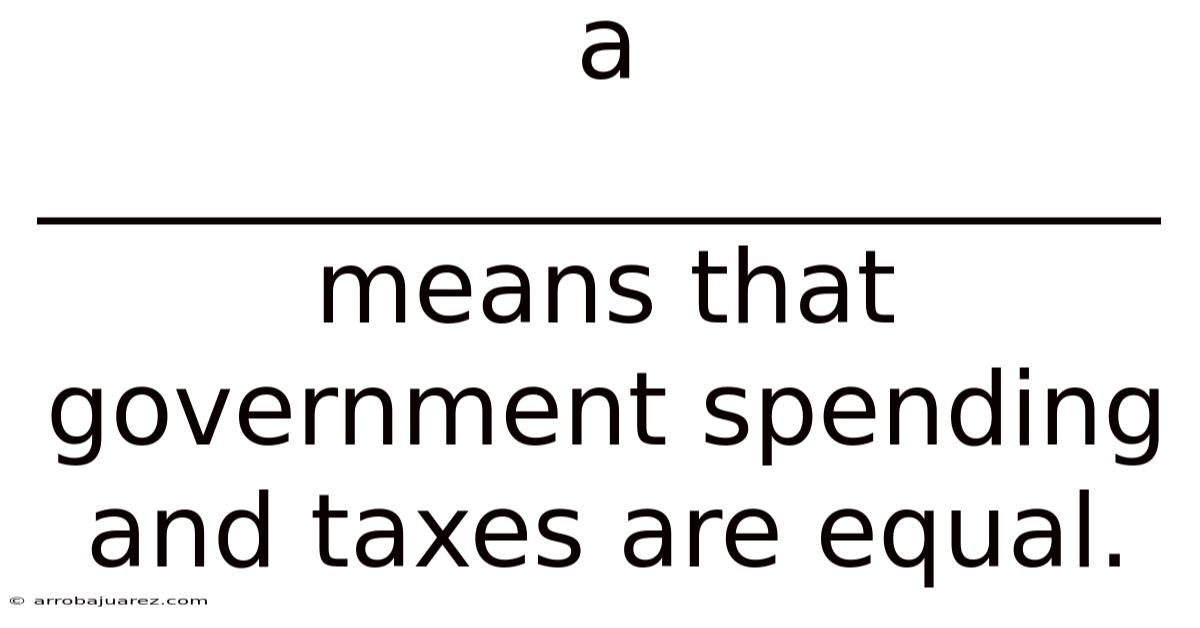
A balanced budget means that government spending and taxes are equal, reflecting a fiscal state where the government's total revenues are sufficient to cover its total expenditures. Worth adding: this concept is a cornerstone of fiscal policy, influencing economic stability, public debt, and the overall health of a nation's economy. Understanding the intricacies of a balanced budget is crucial for citizens, policymakers, and economists alike.
Understanding a Balanced Budget
A balanced budget occurs when a government's total revenues, primarily from taxes, match its total expenditures, which include public services, infrastructure projects, and social welfare programs. This equilibrium signifies fiscal responsibility and sustainability, preventing the accumulation of debt.
Key Components
- Government Spending: This encompasses all expenditures made by the government on various sectors, including education, healthcare, defense, infrastructure, and social security.
- Government Revenue: This primarily includes taxes collected from individuals and corporations, as well as other sources of income such as fees, duties, and profits from state-owned enterprises.
- Fiscal Equilibrium: This is the state where government spending is equal to government revenue, resulting in neither a surplus nor a deficit.
Benefits of a Balanced Budget
- Economic Stability: A balanced budget promotes economic stability by preventing excessive borrowing and debt accumulation.
- Investor Confidence: It enhances investor confidence, as it signals fiscal discipline and reduces the risk of sovereign debt crises.
- Lower Interest Rates: It can lead to lower interest rates, as reduced government borrowing decreases the demand for credit in financial markets.
- Intergenerational Equity: It ensures intergenerational equity by avoiding the burdening of future generations with debt incurred today.
- Fiscal Prudence: It fosters fiscal prudence, encouraging governments to prioritize spending and improve efficiency.
The Mechanics of Balancing a Budget
Balancing a budget requires careful planning, monitoring, and adjustments to both government spending and revenue. Governments employ various strategies to achieve this fiscal equilibrium.
Strategies for Balancing the Budget
- Fiscal Planning:
- Budget Forecasting: Accurate forecasting of future revenues and expenditures is essential. This involves analyzing economic trends, demographic changes, and policy impacts.
- Setting Priorities: Governments must set clear priorities, allocating resources to the most critical areas while cutting back on less essential programs.
- Revenue Management:
- Tax Policies: Adjusting tax rates, broadening the tax base, and improving tax collection efficiency can increase government revenue.
- Diversifying Revenue Sources: Exploring alternative revenue sources, such as user fees, royalties, and privatization of state-owned enterprises, can reduce reliance on taxes.
- Expenditure Control:
- Spending Cuts: Reducing spending in certain areas, such as defense, administration, or subsidies, can lower overall expenditures.
- Efficiency Improvements: Enhancing the efficiency of public services and reducing waste can help achieve more with the same level of spending.
- Debt Management:
- Debt Reduction Strategies: Implementing strategies to reduce existing debt, such as debt buybacks, refinancing, or fiscal consolidation, can improve the fiscal outlook.
- Borrowing Discipline: Maintaining borrowing discipline by avoiding excessive debt accumulation is crucial for long-term fiscal sustainability.
- Economic Growth Policies:
- Investment in Infrastructure: Investing in infrastructure projects can stimulate economic growth, leading to increased tax revenues and improved fiscal outcomes.
- Education and Innovation: Supporting education and innovation can enhance productivity and competitiveness, boosting economic growth and government revenues.
Challenges in Balancing the Budget
- Economic Downturns: Economic recessions can lead to reduced tax revenues and increased demand for social welfare programs, making it difficult to balance the budget.
- Political Constraints: Balancing the budget often involves making difficult choices, such as raising taxes or cutting spending, which can be politically unpopular.
- Demographic Changes: Aging populations and declining birth rates can strain government finances, as increased healthcare and pension costs put pressure on public resources.
- Unforeseen Events: Unexpected events, such as natural disasters, pandemics, or geopolitical crises, can disrupt fiscal plans and require significant unplanned expenditures.
- Policy Lags: The impact of fiscal policies can take time to materialize, making it challenging to fine-tune budget adjustments in response to changing economic conditions.
Economic Theories and Balanced Budgets
Various economic theories offer different perspectives on the role and desirability of balanced budgets. These theories influence policymakers' approaches to fiscal management.
Classical Economics
Classical economists advocate for balanced budgets as a means of maintaining fiscal stability and preventing excessive government debt. In real terms, they argue that government borrowing crowds out private investment, leading to slower economic growth. According to classical theory, governments should minimize their role in the economy, focusing on essential functions such as national defense and law enforcement, and avoid running deficits.
Keynesian Economics
Keynesian economics, developed by John Maynard Keynes, suggests that governments should use fiscal policy to stabilize the economy, even if it means running deficits during recessions. Even so, keynes argued that during economic downturns, government spending can stimulate demand, create jobs, and boost economic growth. According to Keynesian theory, balanced budgets should be viewed in the context of the business cycle, with deficits during recessions offset by surpluses during expansions.
Quick note before moving on.
Modern Monetary Theory (MMT)
Modern Monetary Theory (MMT) challenges conventional views on government debt and deficits. Proponents of MMT argue that a sovereign government that issues its own currency can finance its spending without necessarily relying on taxes or borrowing. According to MMT, the primary constraint on government spending is inflation, not solvency. MMT suggests that governments can use fiscal policy to achieve full employment and other economic goals, without worrying about balancing the budget in the traditional sense.
This is where a lot of people lose the thread Small thing, real impact..
Supply-Side Economics
Supply-side economics emphasizes the importance of tax cuts and deregulation to stimulate economic growth. Proponents of supply-side economics argue that lower tax rates can incentivize investment, productivity, and job creation, leading to increased tax revenues. According to supply-side theory, tax cuts can pay for themselves by boosting economic growth, potentially leading to balanced budgets or even surpluses Most people skip this — try not to..
The Impact of Balanced Budgets on Society
The pursuit and achievement of balanced budgets have profound impacts on various aspects of society, influencing economic well-being, social programs, and public services Which is the point..
Economic Well-being
- Reduced Debt Burden: Balanced budgets reduce the burden of government debt, freeing up resources for more productive uses, such as investment in infrastructure, education, and healthcare.
- Stable Interest Rates: They can lead to stable or lower interest rates, benefiting consumers and businesses by reducing borrowing costs.
- Increased Investor Confidence: They enhance investor confidence, attracting foreign investment and stimulating economic growth.
Social Programs
- Funding Stability: They can provide funding stability for social programs, ensuring that essential services are maintained without the risk of budget cuts due to debt pressures.
- Targeted Spending: They encourage governments to prioritize spending on programs that have the greatest impact on reducing poverty, improving health outcomes, and promoting social mobility.
Public Services
- Infrastructure Development: They enable governments to invest in infrastructure projects, such as roads, bridges, and public transportation, which can improve productivity and quality of life.
- Education and Healthcare: They support investment in education and healthcare, improving human capital and promoting long-term economic growth.
- Public Safety: They ensure adequate funding for public safety services, such as police, fire departments, and emergency medical services, enhancing community safety and security.
Environmental Protection
- Sustainable Development: They can promote sustainable development by encouraging governments to invest in renewable energy, conservation, and pollution reduction.
- Environmental Regulations: They support the enforcement of environmental regulations, protecting natural resources and mitigating the impacts of climate change.
Case Studies: Balanced Budget Experiences
Examining real-world examples of countries or regions that have pursued balanced budget policies provides valuable insights into the challenges and opportunities associated with this fiscal approach Simple as that..
Canada in the 1990s
In the 1990s, Canada faced a severe fiscal crisis, with rising debt levels and a growing budget deficit. The government implemented a series of austerity measures, including spending cuts, tax increases, and privatization of state-owned enterprises. That's why these efforts led to a balanced budget and a significant reduction in government debt. The Canadian experience demonstrates that fiscal consolidation can be successful, but it requires strong political will and a comprehensive approach.
New Zealand in the 1990s
New Zealand also undertook significant fiscal reforms in the 1990s, aimed at balancing the budget and reducing government debt. The government implemented the Fiscal Responsibility Act, which set clear fiscal targets and reporting requirements. Because of that, these reforms led to improved fiscal outcomes, increased investor confidence, and sustained economic growth. The New Zealand experience highlights the importance of transparency, accountability, and long-term planning in achieving fiscal sustainability.
Real talk — this step gets skipped all the time And that's really what it comes down to..
The United States in the Late 1990s
Here's the thing about the United States achieved a balanced budget in the late 1990s, thanks to a combination of factors, including strong economic growth, spending restraint, and tax increases. Practically speaking, the balanced budget led to a reduction in government debt and contributed to a period of sustained economic prosperity. Still, the balanced budget was short-lived, as tax cuts and increased spending led to a return to deficits in the early 2000s. This experience illustrates the challenges of maintaining fiscal discipline over time Surprisingly effective..
Greece in the 2010s
Greece experienced a severe sovereign debt crisis in the 2010s, triggered by unsustainable fiscal policies and a lack of competitiveness. The government implemented a series of austerity measures, including spending cuts, tax increases, and structural reforms, in exchange for financial assistance from the European Union and the International Monetary Fund. The Greek experience highlights the risks of fiscal mismanagement and the painful consequences of unsustainable debt levels.
Future Trends in Balanced Budget Policies
Looking ahead, several trends are likely to shape the future of balanced budget policies, including technological advancements, demographic shifts, and evolving economic paradigms Simple as that..
Technological Advancements
- Digital Government: Technological advancements can improve the efficiency and effectiveness of government operations, reducing costs and enhancing service delivery.
- Data Analytics: Data analytics can help governments make better decisions about resource allocation, targeting spending to programs that have the greatest impact.
- Automation: Automation can streamline administrative processes, reducing labor costs and improving accuracy.
Demographic Shifts
- Aging Populations: Aging populations will continue to put pressure on government finances, as increased healthcare and pension costs strain public resources.
- Migration: Migration patterns can impact government revenues and expenditures, as changing demographics affect the tax base and demand for public services.
- Urbanization: Urbanization can lead to increased demand for infrastructure and public services in urban areas, requiring governments to invest in transportation, housing, and utilities.
Evolving Economic Paradigms
- Green Economy: The transition to a green economy will require governments to invest in renewable energy, sustainable transportation, and environmental protection, potentially creating new revenue streams and reducing long-term costs.
- Inclusive Growth: Policies aimed at promoting inclusive growth can help reduce income inequality and improve economic opportunities for all, leading to increased tax revenues and reduced demand for social welfare programs.
- Global Cooperation: Global cooperation on issues such as climate change, trade, and taxation can help ensure fiscal sustainability and promote shared prosperity.
Conclusion
A balanced budget is a critical concept in fiscal policy, representing a state where government spending equals revenue. While various strategies exist for balancing a budget, challenges such as economic downturns and political constraints can make it difficult to achieve. Practically speaking, examining case studies and considering future trends can provide valuable insights into the challenges and opportunities associated with balanced budget policies. Economic theories offer different perspectives on the role and desirability of balanced budgets, influencing policymakers' approaches to fiscal management. The pursuit of balanced budgets has profound impacts on society, affecting economic well-being, social programs, and public services. Achieving and maintaining a balanced budget promotes economic stability, investor confidence, and intergenerational equity. As governments handle an ever-changing economic landscape, understanding the principles and implications of balanced budgets remains essential for ensuring long-term fiscal sustainability and prosperity.
Short version: it depends. Long version — keep reading That's the part that actually makes a difference..
