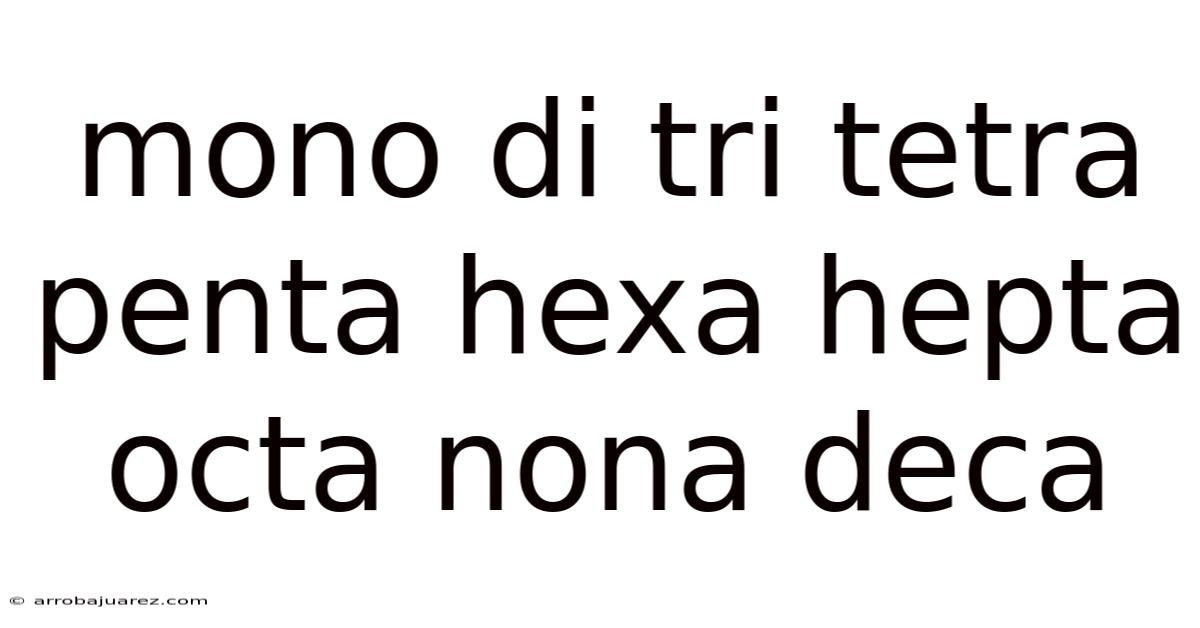
Understanding prefixes in science, especially in chemistry and mathematics, unlocks a systematic way to name compounds, describe shapes, and denote quantities. The prefixes "mono," "di," "tri," "tetra," "penta," "hexa," "hepta," "octa," "nona," and "deca" are fundamental building blocks in scientific nomenclature. Grasping their meanings and applications allows for precise communication and understanding in various fields.
Unveiling the World of Numerical Prefixes
These prefixes, primarily derived from Greek, indicate the number of atoms, molecules, or structural units in a compound or a geometrical figure. They offer a shorthand method for conveying complex information concisely Turns out it matters..
- Mono-: Indicates one.
- Di-: Indicates two.
- Tri-: Indicates three.
- Tetra-: Indicates four.
- Penta-: Indicates five.
- Hexa-: Indicates six.
- Hepta-: Indicates seven.
- Octa-: Indicates eight.
- Nona-: Indicates nine.
- Deca-: Indicates ten.
Diving Deep into Chemical Nomenclature
In chemistry, these prefixes are indispensable when naming covalent compounds. The number of atoms of each element in a molecule is indicated by the appropriate prefix. As an example, carbon monoxide (CO) signifies one atom of carbon and one atom of oxygen, while carbon dioxide (CO₂) indicates one carbon atom and two oxygen atoms Practical, not theoretical..
Rules and Nuances
- The prefix "mono-" is generally omitted for the first element in a compound, unless it's crucial for clarity.
- When the prefix ends in 'a' or 'o' and the element name begins with a vowel, the 'a' or 'o' is often dropped for easier pronunciation (e.g., carbon monoxide, not carbon monooxide).
- These prefixes are used for covalent compounds, not ionic compounds. Ionic compounds are named based on the charges of the ions involved.
Examples in Chemistry
- Carbon Monoxide (CO): A colorless, odorless, and toxic gas. It is produced by the incomplete combustion of carbon-containing fuels. The "mono-" prefix indicates a single oxygen atom bonded to the carbon atom.
- Carbon Dioxide (CO₂): A greenhouse gas produced by respiration, combustion, and decomposition of organic substances. The "di-" prefix specifies two oxygen atoms bonded to the carbon atom.
- Dinitrogen Pentoxide (N₂O₅): A highly reactive oxidizing agent. The "di-" prefix indicates two nitrogen atoms, and the "penta-" prefix indicates five oxygen atoms.
- Sulfur Hexafluoride (SF₆): An extremely potent greenhouse gas and an excellent electrical insulator. The "hexa-" prefix denotes six fluorine atoms bonded to the sulfur atom.
- Phosphorus Pentachloride (PCl₅): A yellowish-white solid that fumes in moist air and is used as a chlorinating agent. The "penta-" prefix indicates five chlorine atoms bonded to the phosphorus atom.
- Dichlorine Heptoxide (Cl₂O₇): A highly explosive compound. The "di-" prefix signifies two chlorine atoms, and the "hepta-" prefix indicates seven oxygen atoms.
Geometrical Marvels: Prefixes in Polygons and Polyhedra
These prefixes also play a important role in geometry when naming polygons and polyhedra. A polygon is a two-dimensional closed figure made up of straight line segments, and a polyhedron is a three-dimensional solid figure with flat polygonal faces.
Polygons
- Triangle: A three-sided polygon (tri-).
- Quadrilateral: A four-sided polygon (tetra- can also be used, as in tetrahedron).
- Pentagon: A five-sided polygon (penta-).
- Hexagon: A six-sided polygon (hexa-).
- Heptagon: A seven-sided polygon (hepta-).
- Octagon: An eight-sided polygon (octa-).
- Nonagon/Enneagon: A nine-sided polygon (nona- or, less commonly, ennea-).
- Decagon: A ten-sided polygon (deca-).
Polyhedra
- Tetrahedron: A four-faced polyhedron, specifically a triangular pyramid (tetra-).
- Pentahedron: A five-faced polyhedron (penta-).
- Hexahedron: A six-faced polyhedron, the most common example being a cube (hexa-).
- Octahedron: An eight-faced polyhedron (octa-).
- Decahedron: A ten-faced polyhedron (deca-).
Mathematical Applications Beyond Geometry
Beyond geometry, these prefixes extend to other mathematical concepts, especially when dealing with sets, combinations, and higher-dimensional spaces.
Combinatorics
In combinatorics, the prefixes can denote the number of elements in a set or the number of ways to choose elements from a set. Though not as formally used as in chemistry or geometry, the concept of counting and enumeration aligns perfectly with the meaning of these prefixes.
Higher Dimensions
In theoretical mathematics and physics, the prefixes can conceptually extend to describe higher-dimensional spaces. Take this case: while we commonly deal with three spatial dimensions, concepts like "ten-dimensional space" are prevalent in string theory, although they might not be visualized as readily as geometrical shapes.
Quick note before moving on.
Biological Contexts: Prefixes in Classifying Life
In biology, while not as pervasive as in chemistry, these prefixes appear in classifying organisms and structures, particularly when quantifying repetitive elements or stages.
Examples in Biology
- Pentadactyl Limb: Refers to the five-fingered or five-toed limb found in many vertebrates (penta-). This is a classic example in evolutionary biology, showing the common ancestry of various species.
- Oligosaccharides: Carbohydrates composed of a small number of monosaccharides (mono- is implied in "monosaccharides"). While "oligo-" is more common for a few units, these numerical prefixes help define the size and complexity of biomolecules.
Everyday Language: Echoes of Numerical Prefixes
The influence of these prefixes extends beyond scientific and mathematical contexts, permeating everyday language.
Common Words
- Monologue: A speech by one person (mono-).
- Dilemma: A situation involving a choice between two equally undesirable options (di-).
- Triathlon: A sporting event involving three disciplines (tri-).
- Tetris: A tile-matching video game based on tetrominoes (tetra-).
- Pentagon: As a building, the headquarters of the U.S. Department of Defense, named for its five-sided shape (penta-).
- Hexagon: Often used in design and engineering due to its structural stability (hexa-).
- October: Originally the eighth month in the Roman calendar (octa-).
- December: Originally the tenth month in the Roman calendar (deca-).
Scientific Instruments and Measurement
In scientific instruments and measurement, the prefixes are crucial for describing scales, units, and components Took long enough..
Examples in Instrumentation
- Spectrometer: An instrument used to measure properties of light over a specific portion of the electromagnetic spectrum. The prefixes can indicate the number of detectors or channels in sophisticated spectrometers.
- Microscopes: While "micro-" is more common for small scales, the basic principles of counting and measurement often rely on quantifying elements, aligning with the conceptual use of numerical prefixes.
Cultural and Historical Significance
The prefixes have deep roots in ancient languages and cultures, influencing not only scientific terminology but also various aspects of human civilization Worth keeping that in mind..
Historical Context
The Greek origins of these prefixes highlight the contributions of ancient Greek scholars to mathematics, science, and philosophy. Their systematic approach to understanding the world laid the groundwork for modern scientific nomenclature.
Cultural Impact
From architectural designs featuring polygonal shapes to literary references incorporating numerical themes, the influence of these prefixes is evident in various cultural expressions.
Modern Technological Applications
In contemporary technology, these prefixes continue to be relevant in fields such as computer science, materials science, and nanotechnology Simple, but easy to overlook..
Technological Examples
- Hexagonal Grids in Gaming: Used for game maps and simulations, providing a balance between visual appeal and computational efficiency.
- Penta-Band Antennas: In telecommunications, antennas designed to operate on five different frequency bands, enhancing connectivity and performance.
- Deca-Core Processors: Computer processors with ten cores, allowing for parallel processing and improved performance in demanding applications.
Advanced Chemical Compounds: Elaborate Naming
As chemical synthesis advances, more complex compounds require a detailed nomenclature system, where these prefixes are indispensable.
Complex Chemical Examples
- Tetraethyllead (TEL): An antiknock agent formerly added to gasoline. The "tetra-" prefix indicates four ethyl groups attached to a lead atom.
- Hexacarbonylmolybdenum(0): A coordination compound with six carbonyl ligands bonded to a molybdenum atom. The "hexa-" prefix signifies six carbonyl groups.
- Heptamolybdate: A polyoxometalate containing seven molybdenum atoms. The "hepta-" prefix indicates the presence of seven molybdenum atoms.
Geological and Astronomical Contexts
Even in fields such as geology and astronomy, these prefixes find occasional use when describing formations or celestial arrangements.
Geological and Astronomical Examples
- Pentagonal Icositetrahedron: A polyhedron sometimes found in mineral crystal structures, having 24 faces, each of which is a pentagon.
- Multiple Star Systems: Systems containing multiple stars, such as triple (tri-), quadruple (tetra-), or even higher-order systems, though specific numerical prefixes beyond "quadruple" are less commonly used.
FAQs: Common Questions Addressed
Why is "mono-" often omitted?
The prefix "mono-" is generally omitted for the first element in a compound because it is understood that if no prefix is present, there is only one atom of that element.
Are these prefixes only used in science?
No, these prefixes appear in various aspects of everyday language and culture, such as in words like "monologue," "dilemma," and "triathlon."
Do these prefixes always indicate the exact number?
In scientific nomenclature, yes, these prefixes are intended to indicate the exact number of atoms, units, or sides. Even so, in informal contexts, they might be used more loosely Small thing, real impact..
How do I remember the order of these prefixes?
Mnemonics can be helpful, such as "My Dog Tries Taking Pictures, On the flip side, He Orders New Donuts," where the first letter of each word corresponds to the prefix Worth knowing..
Are there prefixes for numbers larger than ten?
Yes, prefixes exist for larger numbers, such as "undeca-" (11), "dodeca-" (12), and so on, but they are less commonly used in everyday scientific nomenclature.
Conclusion: The Power of Prefixes
From describing simple chemical compounds to naming complex geometrical shapes, the prefixes "mono," "di," "tri," "tetra," "penta," "hexa," "hepta," "octa," "nona," and "deca" are essential tools in science, mathematics, and beyond. That said, their consistent use allows for precise communication, standardized nomenclature, and a deeper understanding of the quantitative aspects of the world around us. Mastering these prefixes enhances comprehension and appreciation of the fundamental building blocks of scientific knowledge That's the whole idea..
