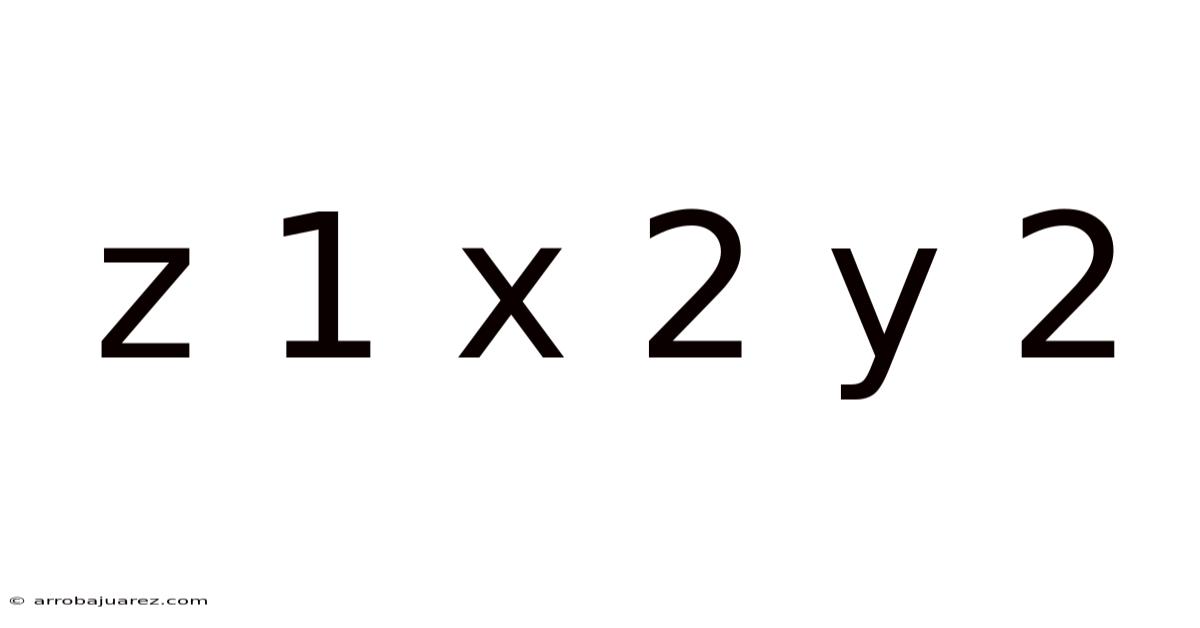
Decoding the Mathematical Dance: Understanding Z1 X 2 Y 2
Mathematics, often perceived as a daunting realm of abstract symbols and complex equations, is, at its heart, a language – a language that elegantly describes the relationships and patterns that govern our universe. This article will look at the components of this expression, exploring their individual significance and how they interact within a broader mathematical context. Even so, within this language, expressions like "Z1 X 2 Y 2" might initially appear cryptic, but with a systematic approach, we can access their meaning and appreciate the mathematical concepts they represent. We will examine the potential interpretations of Z1, X, and Y, the roles of the numbers 1 and 2, and the operations that might be implied. By the end of this exploration, you'll have a comprehensive understanding of the possible meanings and applications of this seemingly simple, yet potentially powerful, expression Easy to understand, harder to ignore..
Unveiling the Variables: Z, X, and Y
In the realm of algebra, letters are not merely characters; they are symbols representing variables. These variables hold the place of unknown quantities, allowing us to formulate equations and explore relationships without knowing the exact numerical values. The beauty of variables lies in their ability to represent a wide range of possibilities, making algebraic expressions incredibly versatile and applicable to numerous scenarios Easy to understand, harder to ignore..
- Z: The variable "Z" is commonly used in mathematics to represent a variety of quantities, depending on the context. In three-dimensional coordinate systems, Z often denotes the vertical axis, representing height or depth. In complex numbers, Z typically represents a complex number in the form a + bi. Z could also be a generic variable representing any unknown quantity within an equation or a function.
- X: The variable "X" is perhaps the most familiar variable in algebra. It's frequently used to represent an unknown quantity that we aim to solve for in an equation. In coordinate geometry, X represents the horizontal axis on a two-dimensional graph. Similar to Z, X can also represent a wide array of quantities depending on the specific problem or context.
- Y: The variable "Y" is commonly paired with X in coordinate geometry, representing the vertical axis on a two-dimensional graph. Together, X and Y define a point's location in a plane. More generally, Y can represent a dependent variable, its value depending on the value of X in a function.
The key takeaway is that the specific meaning of Z, X, and Y is highly dependent on the context in which they are used. Without additional information, we can only speculate on their precise interpretation.
The Significance of Numerical Coefficients and Exponents: 1 and 2
Numbers, unlike variables, represent specific, quantifiable values. In the expression "Z1 X 2 Y 2," the numbers 1 and 2 play crucial roles, potentially acting as coefficients, exponents, or subscripts, each influencing the expression in distinct ways Which is the point..
-
The Number 1: The number 1, seemingly simple, holds fundamental significance in mathematics. It is the multiplicative identity, meaning that any number multiplied by 1 remains unchanged (e.g., 5 * 1 = 5). In the context of "Z1," the "1" could be interpreted in several ways:
- Coefficient: It could represent a coefficient of 1 for the variable Z. In this case, Z1 is simply equivalent to Z, as multiplying Z by 1 doesn't change its value.
- Subscript: It could be a subscript, indicating a specific element within a set of Z values (e.g., Z1 might be the first element in a sequence of Z values). Subscripts are often used to differentiate between multiple related variables.
- Exponent: Although less likely in this specific notation, it could technically be an exponent. Z to the power of 1 (Z^1) is also simply Z.
-
The Number 2: The number 2 is also fundamental, playing a key role in various mathematical operations. In the expression "X 2 Y 2," the "2" could indicate:
- Exponent: The most likely interpretation is that "2" is an exponent. In this case, X 2 would represent X squared (X^2), meaning X multiplied by itself (X * X). Similarly, Y 2 would represent Y squared (Y^2), or Y * Y. Squaring a variable or number results in a quadratic relationship.
- Coefficient: Less likely, but possible, the numbers could be coefficients. On the flip side, it's unconventional to write a variable immediately followed by a coefficient without an operator. If interpreted as coefficients, we would need to assume an implicit multiplication, making the terms 2X and 2Y, respectively.
- Subscript: Similar to Z1, the "2" could be a subscript, indicating X2 and Y2 are specific elements within sets of X and Y values.
Decoding the Implicit Operations: Multiplication and Beyond
Mathematical expressions often rely on implicit operations, meaning operations that are not explicitly written but are understood based on mathematical conventions. In "Z1 X 2 Y 2," the most likely implicit operation is multiplication.
-
Multiplication: In algebra, when variables or numbers are written next to each other without an explicit operator, it is generally understood that they are being multiplied. So, "Z1 X 2 Y 2" is most likely interpreted as Z1 * X^2 * Y^2. This represents the product of Z1, X squared, and Y squared. Given that Z1 is likely equivalent to Z, the entire expression would then be simplified to Z * X^2 * Y^2 Easy to understand, harder to ignore..
-
Other Potential Interpretations (Less Likely): While multiplication is the most probable interpretation, it's worth considering (though less likely without further context) that the expression could represent something different. Take this: it might be part of a larger, specialized notation within a specific field of mathematics or computer science. Without additional information, it's impossible to definitively rule out alternative interpretations, but multiplication is the most standard and reasonable assumption It's one of those things that adds up..
Putting It All Together: Possible Interpretations and Scenarios
Based on the analysis of individual components and the likely implicit operations, here are a few potential interpretations and scenarios where the expression "Z1 X 2 Y 2" might be encountered:
-
Scenario 1: A Volume Calculation: Imagine a three-dimensional shape where X and Y represent the lengths of two sides of a square base, and Z represents the height. Then, X^2 represents the area of the square base, and Y^2 could represent a scaling factor applied to the area. Finally, multiplying by Z would give a modified volume. While unconventional, this could be a simplified representation of a volume calculation in a specific context.
-
Scenario 2: A Statistical Model: In statistics, X and Y might represent independent variables, and Z could represent a dependent variable. The expression Z = Z1 * X^2 * Y^2 could be part of a regression model attempting to explain the relationship between Z and the squares of X and Y. The subscript 1 on Z could indicate that this is the first iteration of the model or a specific parameter within the model Simple as that..
-
Scenario 3: A Function Definition: In programming or mathematics, this could represent a function definition. To give you an idea, f(X, Y, Z) = Z * X^2 * Y^2. This function takes three inputs (X, Y, and Z) and returns a value calculated by multiplying Z with the squares of X and Y.
-
Scenario 4: A Term in a Polynomial: The expression could be a single term within a larger polynomial expression. To give you an idea, consider the polynomial: 3X^3 + 2Y^2 - Z * X^2 * Y^2 + 5. In this case, "Z1 X 2 Y 2" (interpreted as Z * X^2 * Y^2) is simply one part of a more complex expression.
These scenarios highlight the versatility of algebraic expressions. The same expression can represent different things depending on the context and the definitions of the variables involved Practical, not theoretical..
Delving Deeper: Exploring Related Mathematical Concepts
Understanding "Z1 X 2 Y 2" opens the door to exploring several related mathematical concepts:
-
Polynomials: As mentioned in Scenario 4, "Z1 X 2 Y 2" can be a term within a polynomial. A polynomial is an expression consisting of variables and coefficients, combined using addition, subtraction, and multiplication, where the exponents of the variables are non-negative integers. Understanding polynomials is crucial for solving equations, modeling real-world phenomena, and performing various algebraic manipulations Which is the point..
-
Functions: Scenario 3 highlighted the potential for "Z1 X 2 Y 2" to represent a function. A function is a mathematical relationship that assigns a unique output value to each input value. Functions are fundamental to calculus, analysis, and many other branches of mathematics.
-
Coordinate Geometry: The variables X and Y are commonly associated with coordinate geometry. Coordinate geometry uses a coordinate system to represent geometric shapes and figures algebraically. This allows us to analyze geometric properties using algebraic methods and vice versa. The inclusion of Z extends this to three-dimensional space.
-
Regression Analysis: Scenario 2 touched upon statistical modeling. Regression analysis is a statistical technique used to model the relationship between a dependent variable and one or more independent variables. The expression "Z1 X 2 Y 2" could be part of a regression equation, helping to understand how changes in X and Y affect Z.
Common Pitfalls and Misconceptions
When interpreting mathematical expressions, it helps to avoid common pitfalls and misconceptions:
-
Assuming a Universal Meaning: The most common mistake is assuming that a variable or expression has a single, fixed meaning. As we've seen, the interpretation of "Z1 X 2 Y 2" depends heavily on the context. Always consider the surrounding information and the specific problem you are trying to solve.
-
Ignoring Implicit Operations: Failing to recognize implicit operations, such as the implied multiplication in "Z1 X 2 Y 2," can lead to incorrect interpretations. Pay close attention to the notation and mathematical conventions Took long enough..
-
Confusing Coefficients and Exponents: It's crucial to distinguish between coefficients and exponents. A coefficient multiplies a variable, while an exponent indicates the power to which a variable is raised. Misinterpreting these can drastically alter the meaning of the expression.
-
Overlooking the Importance of Context: Context is very important. Without knowing the context in which the expression is used, it's impossible to definitively determine its meaning. Always look for clues and information that can help you understand the variables, operations, and overall purpose of the expression.
Conclusion: Embracing the Ambiguity and Power of Mathematical Expressions
The expression "Z1 X 2 Y 2," while seemingly simple, demonstrates the power and ambiguity inherent in mathematical notation. The beauty of mathematics lies not just in finding definitive answers, but also in embracing the ambiguity and exploring the myriad possibilities that mathematical expressions can represent. Here's the thing — its interpretation depends entirely on the context, the definitions of the variables, and the implicit operations that are assumed. Consider this: understanding expressions like "Z1 X 2 Y 2" is a crucial step in developing a deeper understanding of mathematics and its applications in various fields of science, engineering, and beyond. By carefully analyzing each component, considering possible interpretations, and exploring related mathematical concepts, we can reach the meaning of this expression and appreciate its versatility. Remember to always consider the context, pay attention to notation, and be open to multiple interpretations. This approach will empower you to confidently deal with the world of mathematical expressions and access their hidden meanings.
